
Mode by S is a French editorial platform that covers fashion trends, style advice, and news from the textile industry. Its positioning is based on a clear editorial filter: each piece or trend presented goes through a lens that combines aesthetics, accessibility, and increasingly, environmental traceability of clothing.
Textile environmental labeling: what brands must now show
The French decree n° 2025-957 of September 6, 2025, has launched a voluntary phase of textile environmental labeling. The system relies on a life cycle analysis of the garment and incorporates criteria such as microfiber release or product durability.
For a reader who follows trends, this evolution changes the way to compare two similar pieces. A blended wool coat and a recycled polyester coat will not display the same score, even with identical cuts.
Specialized editorial platforms are beginning to integrate this criterion into their selections. Exploring the entire universe of Mode by S shows how a fashion editorial line can articulate aesthetic favorites and transparency regarding the environmental impact of a garment.

Autumn-winter trends: reading the shows without letting your style be dictated
Autumn-winter trends circulate endlessly on social media, often reduced to a list of colors and cuts. The problem with this format is that it encourages the purchase of pieces disconnected from one’s existing wardrobe.
A more useful approach is to identify the underlying themes rather than the micro-trends. Three recurring axes deserve attention:
- The return of textured materials (corduroy, twisted knit, reimagined tweed), which allow for adding depth to a monochromatic outfit without multiplying accessories.
- Voluminous shoulder cuts, inherited from 1980s men’s wardrobes, adapted this season to softer fabrics to avoid a suit-like effect.
- The palette of browns and rusts, which is gradually replacing all-black in the offerings of French and European designers.
Adopting a foundational trend rather than a viral effect reduces the risk of ending up with unusable pieces by the next season. It is also a direct lever to limit compulsive wardrobe renewal.
Style advice: building a coherent wardrobe rather than an accumulative one
The most common fashion advice is to list “necessary basics.” The flaw in this approach is that it ignores body shape, lifestyle, and local climate.
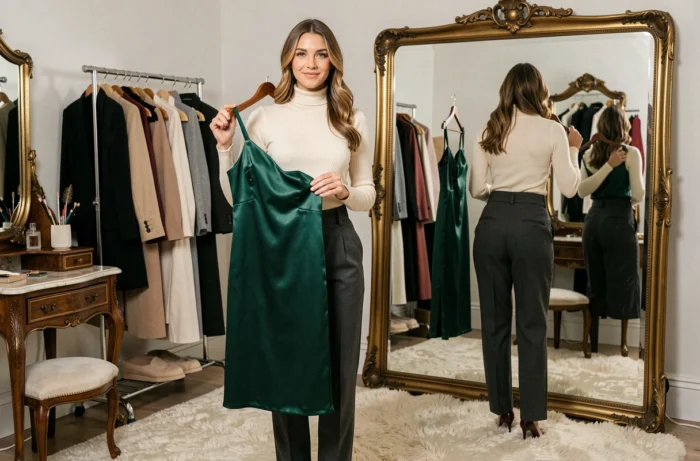
A more operational framework is based on the principle of a contextualized capsule wardrobe. The idea is not to own a fixed number of pieces, but to ensure that each garment can be combined with at least three others already present in the closet.
Concrete method to test the coherence of a purchase
Before buying a piece, mentally compare it to three existing outfits. If it only fits into one, it risks remaining hanging on its hanger. If it works with three combinations or more, the purchase has real stylistic utility.
This grid also applies to trendy pieces. An oversized brown tweed blazer may seem very “seasonal,” but if it complements a raw denim, a wide beige pant, and a black midi dress already owned, it becomes a sustainable investment.
Ban on destroying unsold items: the impact on fashion collections
Since July 19, 2026, the destruction of unsold clothing is prohibited for large companies in the European Union. This measure, stemming from the European regulation on the eco-design of sustainable products (ESPR, EU regulation 2024/1781), concerns clothing, accessories, and shoes. Medium-sized enterprises will be subject to the same obligation starting in 2030.
For consumers, this regulation has visible effects. Brands are adjusting their production volumes and developing more structured clearance channels.
Second-hand and fast fashion: a blurred boundary
A debate is emerging around second-hand: some fast fashion players are entering this segment to offload their surpluses under a virtuous label. The question raised by several observers, particularly in the columns of Nouvel Obs, is whether mass resale does not reproduce the same overproduction logics under another name.
Trends, style advice, and regulatory frameworks converge towards the same point: fashion is becoming a field where verifiable information weighs as much as visual inspiration. Platforms that articulate these two dimensions, factual data and aesthetic perspective, offer a more solid reading filter than simple seasonal compilations.