A child who refuses to get dressed in the morning, another who cries at the school gate without being able to explain why. These situations require considerable energy, especially when the parent is going through a period of fatigue or loneliness. Supporting a child’s development with kindness does not require being perfect or available at every moment. It starts with a few concrete adjustments, tailored to the daily reality of each family.
Supporting your child when you are an exhausted or isolated parent
You may have noticed that parenting advice often assumes a rested adult, surrounded by others, with time on their hands? The reality is different for many families. A single parent, a parent who juggles workdays without support, a parent far from their family: exhaustion changes the game.
When fatigue sets in, reactions become more intense. A report by Terra Nova on parenting highlights the importance of developing local groups for parents of newborns, relying on maternal and child protection services and postnatal visits. The idea is not to delegate education but to break the isolation that makes every difficulty harder to bear.
Specifically, participating in a parent group at a maternal and child protection service or community center allows for discussions about specific situations. Hearing that another child of the same age is going through the same phase of tantrums reassures and provides insights that one might not have found alone. To learn more about Naturally Mom, additional resources address these stages of child development with a practical perspective.
Lowering your expectations on difficult days is an act of kindness towards yourself. If dinner is simpler than expected, if the bedtime routine is skipped one night, the child’s development does not suffer. What matters is consistency over time, not the perfection of each day.

Managing emotions in children: naming before correcting
A child who hits, screams, or rolls on the ground is expressing something they cannot yet articulate with words. Before the age of three, the brain does not allow for self-regulation of strong emotions. The parent’s role is primarily to put words to what the child is feeling.
For example, in response to a child pushing a peer at the park, a phrase like “you are angry because he took your bucket” does more than “stop, that’s bad.” The first phrase helps the child connect a physical sensation to a word. The second stops the behavior without providing any tools for the next time.
Three guidelines for handling an emotional crisis
- Get down to the child’s level physically, by squatting, and speak in a calm voice even if yours trembles a bit. Eye contact at the same height reduces tension.
- Describe what you observe rather than judging: “I see that you are crying, your fists are clenched” gives the child a mirror of their state without labeling them.
- Wait for the emotion to subside before explaining the rule. A child overwhelmed by anger or sadness cannot process an educational instruction. The time it takes to return to calm varies by age and temperament.
This approach, rooted in positive discipline, does not mean accepting everything. The limit remains clear (we do not hit), but it is set after acknowledging the emotion, not instead of it.
Parental technoférence and quality time: protecting daily interactions
The Terra Nova report highlights a phenomenon that is still little discussed: technoférence, meaning the interruption of parent-child interactions by the adult’s phone use. We often talk about children’s screen time, but a parent’s phone use during shared moments also affects development.
A child recounting their day while the adult checks notifications receives a signal: what you are saying is not a priority. This is not a matter of guilt; it is a simple mechanism of shared attention.
Creating pockets of real availability
You do not need to put your phone away for the entire evening. Identifying two or three fixed moments is enough. Meal times, bath time, bedtime reading: putting the phone in another room during these times changes the quality of the exchange without requiring an excessive effort.
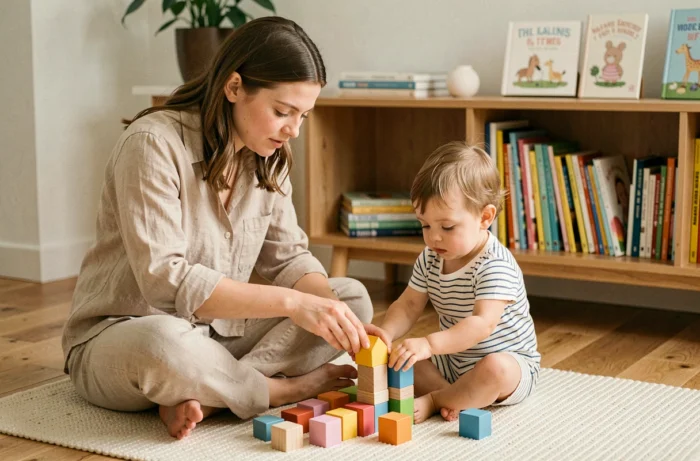
Free play also fits into these moments of connection. A child building a tower of blocks while the parent sits nearby, available but not directing, develops both their autonomy and sense of security. Terra Nova recommends strengthening local play areas and toy libraries for families lacking space at home.

Adapting your kind education according to the child’s age
What works at two years old does not work at six. A toddler needs stable routines and simple limits, repeated without variation. A school-aged child begins to understand the “why” behind the rule and can participate in developing certain family guidelines.
With a preschooler, learning occurs through imitation and repetition. Showing how to put away their shoes rather than asking “put your shoes away” produces a more lasting result. The child encodes the action before understanding the verbal instruction.
By six or seven years old, offering framed choices boosts confidence. “Do you prefer to do your homework before or after snack?” allows for some autonomy while maintaining the framework. The child learns to decide, which prepares them for managing responsibilities later.
- Before three years: prioritize predictable routines, short phrases, and reassuring physical contact during transitions (leaving home, bedtime).
- Between three and six years: introduce simple explanations about rules, allow the child to try tasks independently (pouring water, putting on their socks).
- After six years: involve the child in certain daily decisions, encourage verbalization of their emotions and disagreements rather than acting out.
Kind education is not a rigid method. It adjusts to each child’s temperament, their developmental pace, and the parent’s real resources. On days when everything goes awry, returning to a single concrete gesture (a hug, a phrase that names the emotion, five minutes of uninterrupted play) is enough to maintain the bond. It is this bond, repeated day after day, that builds trust.