Ear stretchers are among the oldest known body modifications. Long before jewelry stores and piercing studios, communities on several continents stretched their lobes to mark a passage, a rank, or a sense of belonging. This practice, far from disappearing, is experiencing a resurgence in contemporary fashion, driven by new materials and an aesthetic that blends cultural heritage with personal style.
Lobe stretching: a technique distinct from classic piercing
Have you ever noticed the difference between a simple earring hole and a visibly enlarged lobe? Lobe stretching is a gradual transformation. It starts from a healed piercing, then the diameter of the inserted jewelry is gradually increased.
This distinction matters, including from a regulatory standpoint. In France, the training rules for piercers evolved in 2024, but they pertain to body piercing, not the progressive stretching of an already pierced lobe. The two practices fall under different frameworks.
A specialized guide recommends waiting for the complete healing of the initial piercing before attempting any enlargement. Pain or bleeding indicates that progression should stop and advice should be sought. Each size increase requires several weeks, sometimes several months, before moving on to the next one. To better understand the evolution of stretchers on Murano Bijoux, this slow process sheds light on the connection between the ritual patience of the past and current practice.
Ear stretchers in tribal cultures: uses and meanings
Lobe stretching did not originate in a Western tattoo parlor. Archaeological evidence confirms this practice across several continents in very ancient times.
In Africa, the Mursi of Ethiopia insert stone labrets into their lower lip and stretch their lobes. The diameter achieved is significant: it indicates maturity and status within the group. In Central America, stretchers have been found in Guatemala, dating back several centuries before our era.
Lobe stretching served as a social marker, not just an ornament. In many of these cultures, the size of the opening indicated the rank, age, or spiritual role of the person. The materials used (bone, wood, stone, shell) varied according to local resources and carried their own symbolic weight.
Some documented functions of stretchers in traditional societies include:
- Marking a rite of passage into adulthood, often accompanied by other body modifications
- Signaling a high social status, as in ancient Egypt where gold hoops indicated nobility
- Fulfilling a spiritual or protective role, with some communities attributing the ability to ward off evil spirits to the ear jewelry
These practices were not limited to one continent. From pre-Columbian civilizations (Aztecs, Mayans) to Asian kingdoms, the modified ear told something about the person wearing it.
Materials and sizes: what has changed with contemporary fashion

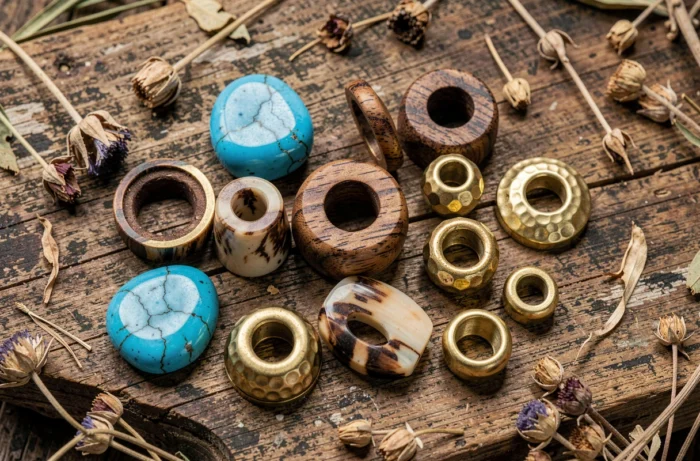
The transition from tribal tradition to urban trend has transformed materials and formats. Modern plugs and tunnels come in surgical steel, titanium, glass, silicone, or exotic wood. Each material has different properties in terms of weight, skin tolerance, and visual appeal.
The choice of material directly influences the comfort and health of the lobe. Titanium and glass are often recommended for the initial stages of stretching, as they are smooth, hypoallergenic, and easy to clean. Silicone, on the other hand, is discouraged on an unstabilized lobe: its flexibility can cause micro-adhesions.
On the aesthetic side, the current trend values crafted pieces. Sculpted, engraved, gem-set stretchers, or those featuring patterns inspired by tribal art can be found. The line between fashion jewelry and body modification is blurring. Some collections integrate stretchers into a cohesive set with other ear piercings, following the principle of “Curated Ear,” where each piece is designed as part of a whole.
Reversibility of stretching: what specialists say
Before diving in, a common question arises: can one go back? The return to an unstretched lobe is not guaranteed. The ability to retract depends on the size reached and the elasticity unique to each person.
Specialized stretching guides indicate that up to a certain size, the lobe can regain a near-normal appearance if the jewelry is permanently removed. Beyond that, the skin remains stretched.
When the lobe does not retract, surgical repair may be considered. Medical articles dedicated to loboplasty report that motivations for this surgery include changes in personal context: career evolution, aesthetic fatigue, or simply a new chapter in life. The procedure remains relatively simple, but it leaves a scar and requires a healing period before any potential new piercing.
Some guidelines before stretching your lobes:
- Wait for the complete healing of the initial piercing, usually several months
- Progress in one-millimeter increments, respecting the resting time between each step
- Use appropriate materials (titanium, glass) and avoid forcing, even slightly
- Accept that reversibility decreases as the diameter increases
Lobe stretching remains one of the few body modifications whose history spans millennia without interruption. From stone labrets of the Mursi to titanium tunnels sold online, the gesture has changed context, not nature. What is at play in an ear stretcher is always an identity choice, whether tribal, spiritual, or purely aesthetic. The difference today is that we have better materials and more accessible information to do it while minimizing risks.