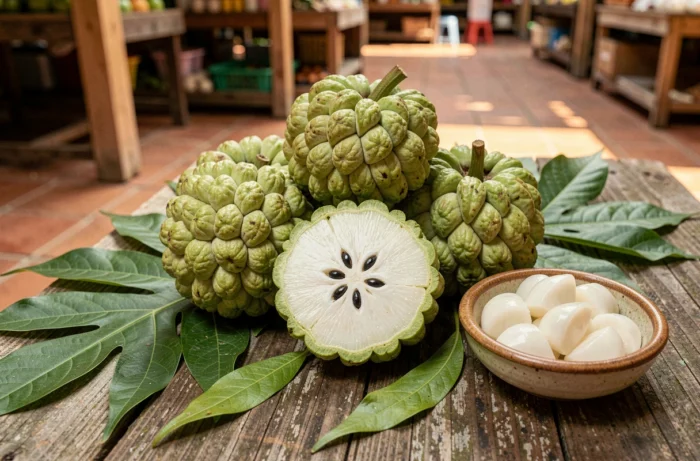
Annona refers to the fruit of several species in the Annona genus (Annonaceae family), of which cherimoya (Annona cherimola) and sugar apple (Annona squamosa) are the two varieties most widely sold in France. They share white, creamy flesh dotted with toxic black seeds, and an aromatic profile that ranges from strawberry to vanilla and banana, depending on the cultivar.
Hand pollination and the agronomic challenges of growing cherimoya
The cherimoya tree is a protogynous dichogamous species: its female organs mature before its male organs, making self-pollination almost impossible in commercial orchards. In Andalusia, Europe’s main production area, growers pollinate the flowers by hand, one flower at a time, to ensure an acceptable fruit-set rate.
This requirement goes a long way toward explaining the high price of cherimoya in French shops. An orchard that relies on skilled labor for pollination cannot compete on volume with tropical crops that use conventional insect pollination.
The Andalusian harvest is not limited to the winter window often cited. It can begin as early as September and continue into spring, with a peak in autumn. This extended season depends on the altitude of orchards along the Costa Tropical of Granada and Málaga, where the subtropical microclimate allows fruit to ripen over a longer period. To better understand the calories in annona, this exotic fruit, it helps to consider the different varieties, since nutritional composition varies considerably from one species to another.
DOP Chirimoya de la Costa Tropical: a little-known label in France
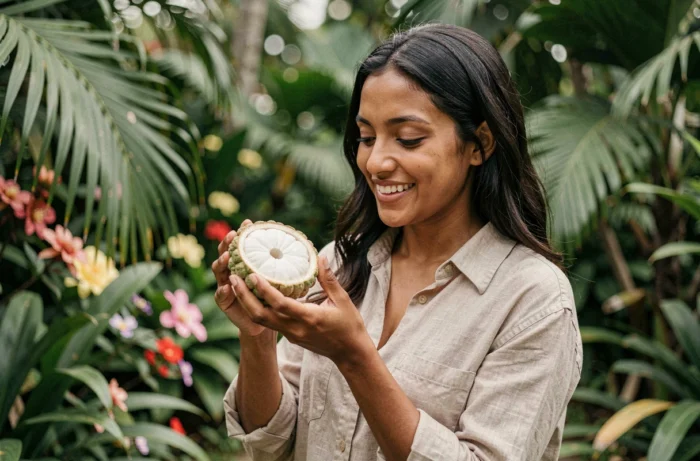
Spanish cherimoya has a protected designation of origin (DOP) called “Chirimoya de la Costa Tropical de Granada-Málaga.” The label regulates the permitted varieties (mainly Fino de Jete and Campas) and sets a minimum maturity threshold based on the fruit’s sugar content at harvest.
The DOP label rarely appears on French shelves. Most annona sold in supermarkets or greengrocers do not carry this designation, making it difficult for consumers to trace their origin. To identify fruit with the designation, check the label or buy from specialist retailers.
Fino de Jete and Campas: two distinct profiles
Fino de Jete dominates Andalusian production. Its flesh is especially soft, with a favorable flesh-to-seed ratio. Campas, which is less common, has smoother skin and a slightly more tart flavor. Both varieties are eaten raw, with a spoon, when the skin yields to gentle pressure from a finger.
Annona’s nutritional profile: beyond the vitamin claims
At around 100 kcal per 100 g, annona is at the higher end of the fresh-fruit calorie range, comparable to a banana. It is not a “light” fruit in terms of calories, despite what some articles suggest when they describe it as low-calorie without comparing it with other fruits.
Its composition per 100 g, according to available nutritional data:
- Carbohydrates: 25.2 g, mostly simple sugars (fructose and glucose), which explains its very sweet flavor when ripe
- Fiber: 2.4 g, a moderate amount that supports digestive comfort but does not make it a major source
- Potassium: a notable amount, useful for regulating blood pressure, along with magnesium and calcium
- Vitamins C and B6: vitamin C supports immune function, while B6 helps metabolize amino acids
The key takeaway: annona is an energy-rich fruit, not a low-calorie one. We recommend including it as a source of natural carbohydrates in a snack rather than treating it as a “weight-loss” food.
Annonacin and soursop: a distinction worth making
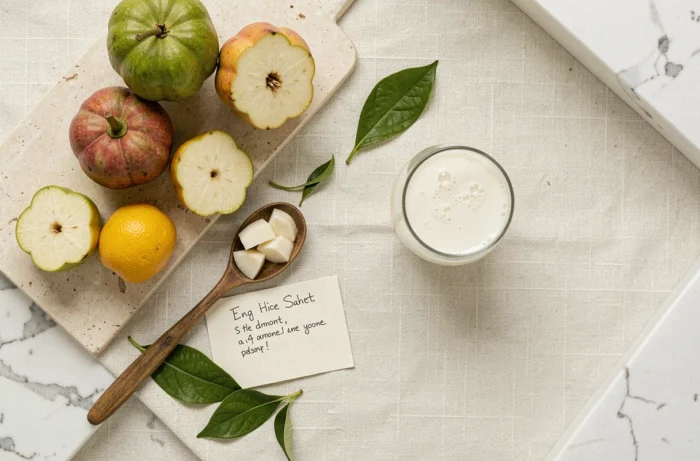
Annona (cherimoya, sugar apple) is often confused with soursop (Annona muricata), also known as graviola. This confusion is not harmless from a health perspective. Soursop contains annonacin, a neurotoxic acetogenin whose regular consumption has been linked to atypical forms of parkinsonism in epidemiological studies conducted in the Caribbean.
Cherimoya and sugar apple also contain acetogenins, but concentrations vary depending on the species and part of the fruit. The toxic black seeds contain most of these compounds. Occasional consumption of the flesh has not been documented to cause problems, but marketing claims that conflate “annona” with “anticancer soursop” are an extrapolation not validated by health authorities.
Seeds and leaves: what not to eat
Annona seeds are toxic, regardless of the species. They should never be chewed or swallowed. Soursop leaves, sold as herbal tea through some outlets, are regularly subject to warnings because of their annonacin content. Do not assume that the properties of one species apply to the entire Annona genus—that is the basic rule to follow.
How to choose and eat a ripe annona: reliable signs
You cannot judge whether an annona is ripe by the color of its skin, which remains green even when fully ripe in most varieties. The only reliable indicator is softness: the fruit should yield slightly when pressed with your thumb, like a ready-to-eat avocado.
A firm fruit will ripen in a few days at room temperature. Refrigeration stops the ripening process and affects the texture of the flesh. Once cut open, the fruit oxidizes quickly, so eat it within an hour: cut it in half, scoop it out with a spoon and remove the seeds as you go.
Sugar apple, recognizable by its segmented skin, which develops a whitish powdery coating as it ripens, breaks down more easily than cherimoya. It is better suited to smoothies or purées than to eating with a spoon.
Annona remains a niche fruit in France, dependent on small-scale production and a fragile supply chain. Its ideal eating window is measured in hours rather than days, limiting its distribution to local outlets and specialist greengrocers.