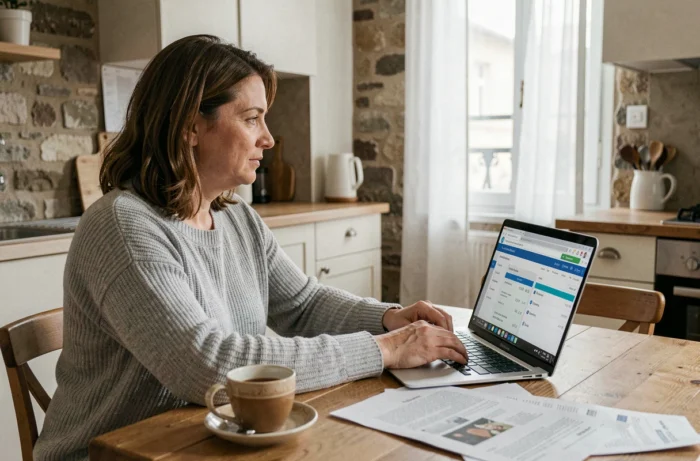
Your child comes home from middle school and tells you that a late arrival has been recorded on their file, even though you notified the school that morning. You log in to the online learning platform to check, but the supporting document is nowhere to be found. This kind of situation is common in Île-de-France, where online school tracking tools vary from one department to another and from one school level to another.
Absence note not visible on the online learning platform: who to contact to correct the record
You submitted an excuse note or emailed the school. Yet the absence is still marked as “unjustified” on the online platform. There is a simple explanation for this discrepancy: the school’s student services team processes the supporting document, not the IT system.
In practice, a senior education adviser (CPE) or teaching assistant receives the document, then manually updates the status in the software (Pronote, Skolengo or another platform). If this update is delayed, the parent interface will continue to show the absence as unjustified.
The best thing to do is contact the school’s student services office directly, by phone or through the platform’s internal messaging system. The main office can also direct your request, but the CPE is the person who manages the absences module. You can find student services information on EduNews to help you locate the relevant sections on your portal.
Another common issue is being unable to access the online learning platform account itself. You may have forgotten your password, never activated your login, or changed schools during the year. In that case, contact the school’s digital learning coordinator first, often a designated teacher, or the main office, which can reset your access details.
Online learning platforms in Île-de-France: different portals depending on school level and department
Have you noticed that the interface changes completely when a child moves from middle school to high school? That’s not a bug. Middle schools use platforms managed at the departmental level, while public high schools in the Île-de-France region use monlycee.net. This transition means a new online space, new login details and sometimes different student services software.
Even within the same department, login procedures can differ. For example, middle schools in Yvelines and Essonne use separate portals. There is no single user guide for the entire region.
In practice, this means three things for families:
- Starting at a new school may require creating an account on a different portal, using login details provided by the school or through EduConnect.
- The “absences”, “late arrivals” and “report cards” sections are in different places depending on whether the platform uses integrated Pronote, Skolengo or another module.
- Parents with children at two different schools (a middle school and a high school, for example) will need to switch between two separate platforms to check the same types of information.
Logging in through EduConnect, the French Ministry of Education’s national portal, provides access to several services with a single login. It is the most reliable starting point if you can no longer find your login details.
Online absences and late arrivals: what the screen shows and what it really means
On the parent interface, an absence usually has a status: justified, unjustified or pending. A late arrival may be recorded in minutes or simply flagged. But an absence recorded online is not a legal tally of truancy.
Truancy reports to the local education authority are based on a precise calculation made by the school: the number of unjustified half-days of absence over a given period. This tally is not always visible to parents on the online platform.
Explained absence, justified absence: the distinction matters
When you send a note explaining that your child was ill, you provide a reason for the absence. The school then decides whether to consider it justified. In most cases, medical or family reasons are accepted without difficulty.
A reason considered insufficient (personal convenience, for example) may remain classified as “unjustified” even if you notified the school. The CPE is the sole decision-maker on the final classification.
Repeated late arrivals: tracked separately from absences
Late arrivals are often handled in a separate tab. Depending on the school’s rules, a certain number of late arrivals may be reclassified as an absence. This rule varies from one middle or high school to another and is rarely displayed on the online platform. Check the school rules provided at the start of the year to find out what threshold applies.
Online school reports: where to find them and what to check
The termly report is finalized after the class council meeting. In Île-de-France, it is generally available on the school’s online platform within a few days. Some middle and high schools also send a paper copy or a PDF by email.
The online report includes grades, teachers’ comments and the class council’s assessment. Check that the grades match what your child received in class. Data entry errors are rare but possible; report any you find to the form teacher.
The student’s digital record (LSU), which covers elementary and middle school, can be accessed online through the service-public.fr website using EduConnect. This record follows the student from one school to another.
Student services data and GDPR: what the online platform records
The online platform does more than track grades and absences. It also records login activity and browsing data: when a parent logged in and which pages they viewed. This information is governed by the GDPR.
In practice, you can ask the school what data is stored and for how long. You have the right to access and correct it. If information about you or your child is inaccurate in the student services module, you are entitled to request a correction through the headteacher or the academy’s data protection officer.
Online school tracking makes communication between families and schools easier, provided you know who to contact when the platform does not reflect what actually happened. In every case, the student services office remains the most direct point of contact for questions about absences, late arrivals or school reports.