
Your half-marathon is coming up. You’ve completed your interval sessions, long runs and mental preparation. One factor is often underestimated: what you eat and drink before, during and after the 21 km. A poorly planned nutrition strategy can turn a well-managed race into a digestive nightmare, even if you’re in excellent shape.
Train your gut: the foundation training plans often overlook
Have you ever felt queasy after taking a gel on a long run? The gel isn’t the problem—it’s the lack of practice. Your digestive system adapts to what you regularly ask it to handle.
A systematic review published in 2023 confirms that practising your race-day fueling strategy during training improves digestive tolerance. In practical terms, this means testing the same gel brand, drink and timing on several long runs.
Intensity and heat can make digestive issues worse. A product you tolerate well at an easy pace may cause problems at half-marathon pace. Recreating race-day conditions (pace, temperature and hydration) during training is still the best way to fine-tune your fueling plan. Getting your half-marathon nutrition right starts with putting it to the test.
What and when to eat before a half-marathon
The night before
Your pre-race dinner doesn’t need to be a giant pasta feast. The goal is to top up your muscle glycogen stores with a meal rich in easy-to-digest complex carbohydrates. White rice, al dente pasta and steamed potatoes are tried-and-true options.
Avoid foods high in fiber and fat the night before: large servings of raw vegetables, legumes and fried foods. This isn’t a permanent dietary rule, just a one-off precaution to reduce the risk of digestive issues the next day.
Breakfast on race day
Eat at least three hours before the start. Why leave that much time? Your stomach needs time to empty and reduce the risk of reflux during exercise.
- An easy-to-digest source of carbohydrates: white bread, cooked oatmeal or a ripe banana
- A small amount of protein: plain yogurt or a slice of ham
- Keep fat to a minimum: avoid too much butter or heavy pastries
- Still water, sipped slowly and in moderation so you don’t overfill your bladder
A breakfast you’ve tested in training is better than one that’s theoretically perfect. If you’ve never had porridge before a long run, race morning is not the time to try it.
Half-marathon nutrition: managing your energy over 21 km
For most runners, a half-marathon takes between 1 hour 15 minutes and just over two hours. Over that length of time, glycogen stores start to drop significantly, especially at a fast pace.
Start fueling early, before you feel hungry. Feeling hungry during a race is a sign that your body is already running low on energy. Taking your first serving of carbohydrates between kilometers five and seven, then topping up regularly, helps keep your blood sugar stable.
What to take with you
Energy gels are still the most convenient option: compact, pre-portioned and quick to absorb. Fruit pastes or pouches of applesauce are alternatives for runners who struggle with very sweet textures. One thing to keep in mind: specialized products aren’t necessarily more effective than everyday foods. A review cited by the Gatorade Sports Science Institute found no clear benefit of carbohydrate hydrogels for digestive tolerance.
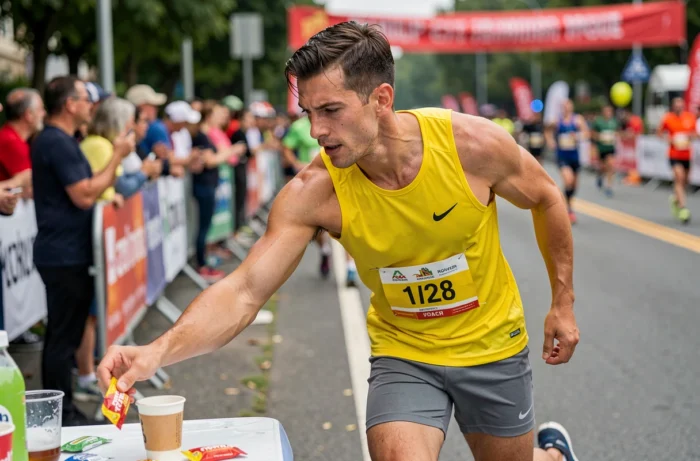
For hydration, drink regularly at aid stations. A sports drink (water, carbohydrates and sodium) helps replace both fluids and energy. If you’re drinking only water, add a gel or solid food to get the carbohydrates you need.

What to eat after a half-marathon: recover the right way
Once you cross the finish line, your body starts rebuilding. Your muscles have used up much of their glycogen and sustained micro-damage from repeated impact.
The post-exercise recovery window is real, but it’s not an emergency. Eating within two hours of finishing helps speed up glycogen replenishment. There’s no need to force down a full meal if you don’t have an appetite.
A snack with both carbohydrates and protein will do the job: a banana with a few almonds, a chicken sandwich or a bowl of rice with cottage cheese. The idea is to get carbohydrates to replenish your energy and protein to support muscle repair.
Rehydrating after the race
Keep drinking after you finish, in small amounts. Mineral water rich in sodium or a salty broth helps replace minerals lost through sweat. Avoid alcohol for the first few hours: it slows rehydration and interferes with recovery.
- Drink regularly in the hours after finishing, without waiting until you’re thirsty
- Choose mineral water or a recovery drink containing sodium
- Save the celebratory meal (pizza, beer) for dinner or the next day, once you’ve made good progress on rehydrating
Your main recovery meal is dinner: a complete, balanced meal with cooked vegetables, a source of protein and starchy carbohydrates. It builds on what your post-race snack has already started.
Half-marathon nutrition is something you prepare over several weeks, not the night before. Testing every food, gel and drink in real training conditions is the only reliable way to find out what works for your body. The best nutrition plan is the one your stomach has already approved.