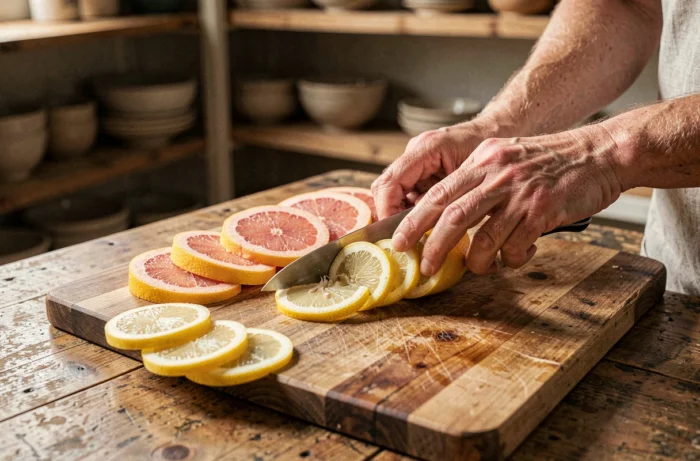
The dehydration of citrus fruits relies on a balance between low temperature, air circulation, and patience. Lemons and grapefruits present specific challenges related to their water content, the thickness of their albedo, and their acidity. Mastering these parameters avoids the two classic pitfalls: slices that are browned on the outside but still moist in the center, or brittle rounds with no residual aroma.
Case hardening on citrus: understanding surface hardening
Case hardening is the most common technical defect in citrus slices. A temperature that is too high causes a dry crust to form on the periphery while the center of the slice retains trapped moisture. The result feels dry to the touch, but preservation is compromised.
On a lemon or grapefruit, the risk is heightened by the albedo (the white part beneath the zest). This spongy layer retains water longer than the pulp. Drying at too high a convection heat creates a moisture differential between the outside and the center that simply extending the drying time does not correct.
To follow a reliable recipe for dehydrated lemons and grapefruits, we recommend maintaining a moderate and constant temperature rather than trying to shorten the process. Raising the temperature does not reduce the shelf life; it simply shifts the problem to a texture defect that is invisible to the naked eye.
Slice thickness and preparation of lemon and grapefruit slices
The thickness of the slice determines both the drying time and the final texture. Citrus fruits shrink significantly during dehydration. Slices that are too thin become brittle and lose all taste appeal. Slices that are too thick dry unevenly, especially at the albedo of the grapefruit.
Calibration and consistency
Cutting consistency takes precedence over absolute thickness. A variation in thickness within the same batch creates slices that finish at different times, complicating monitoring. A well-sharpened knife or a mandoline set to a constant notch yields better results than freehand cutting.
- Lemons: their small diameter and high acidity allow for relatively uniform drying, provided that the seeds are removed, which create localized moisture areas.
- Grapefruits: the wider diameter and thick albedo require increased vigilance. Each slice contains proportionally more spongy material than a lemon, which lengthens the drying time.
- Oranges: fall in between in terms of behavior, but their higher sugar content promotes browning if the temperature rises.
Washing and drying the fruits before cutting remains a non-negotiable step, especially for non-organic citrus fruits whose skins carry treatment residues.
Temperature and drying time in the oven or dehydrator
The choice between oven and dehydrator is not just a matter of equipment. Air circulation radically changes the behavior of drying.
Oven drying with convection heat
A convection oven provides sufficient ventilation for most home uses. Convection heat ensures a more uniform distribution than a static oven, but the airflow remains lower than that of a dedicated dehydrator. Leaving the oven door slightly ajar allows moisture to escape instead of recirculating within the chamber.
Turning the slices halfway through compensates for the lack of cross airflow. Without this action, the side in contact with the rack dries more slowly and may stick.
Dehydrator drying
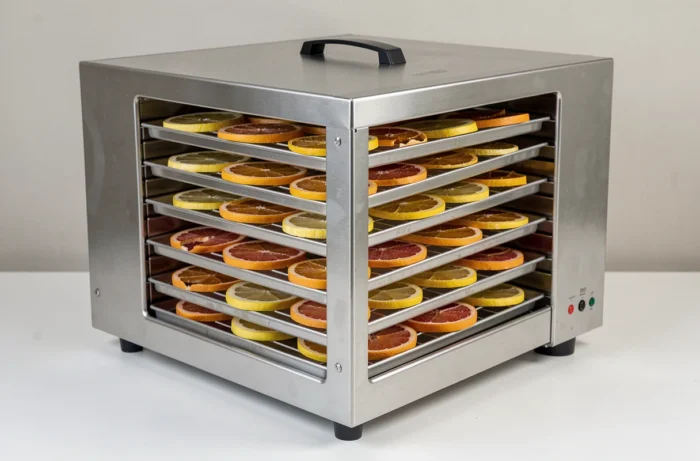
The dehydrator maintains a constant airflow through the stacked trays. For citrus fruits, this advantage translates into more even drying without frequent manual intervention. Rotating the trays (top to bottom) remains useful depending on the models, as the distance to the heat source influences the dehydration speed.

Packaging after drying: the step most recipes overlook
Removing the slices from the oven or dehydrator does not mark the end of the process. Post-drying packaging redistributes residual moisture between the pieces and allows for the detection of incomplete drying before final storage.
The method involves placing the cooled slices in a clean, sealed container. After a few days, if condensation appears on the walls, the slices must return to the dehydrator or oven. This check is particularly relevant for grapefruit, whose albedo can retain moisture that is undetectable to the touch.
Evaluating texture when cold
Testing a slice while still warm gives a false impression of flexibility. Always cool a slice before assessing its final texture. A properly dehydrated slice should be flexible without being sticky. If it breaks cleanly, the drying has gone too far for use in decoration or cocktails. If it bends and leaves a wet mark, it is not ready.
Storage and uses of homemade dehydrated citrus
Well-packaged slices can be stored for several months in an airtight container, away from light and ambient moisture. Dehydrated lemons retain their acidity and can be used in infusions, cocktails, or as garnish. Grapefruits offer a subtle bitterness appreciated in mixology and baking.
For candied grapefruit peels (a preparation distinct from simple dehydration), several successive blanchings are necessary to mitigate the pronounced bitterness of the albedo. This process may require up to eight passes in boiling water, making it a technique in its own right.
Dehydrating citrus at home requires neither expensive equipment nor advanced skills. Success hinges on three controllable parameters: consistent cutting, moderate temperature, and rigorous post-drying packaging. Neglecting any of the three is enough to compromise the result, regardless of the chosen fruit.