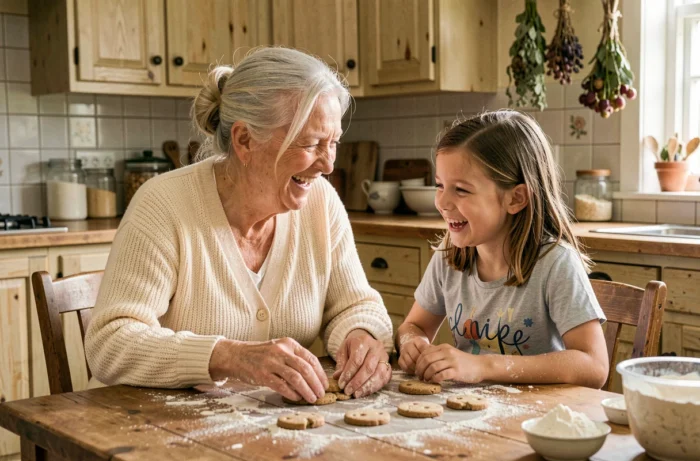
Oma does not simply translate as “grandmother.” The term carries a specific affectionate tone, distinct from the formal word grootmoeder, and its use varies depending on whether you are in the Netherlands, Flanders, or a German-speaking context. Understanding these nuances helps avoid common inaccuracies in bilingual resources.
Oma, grootmoeder, bomma: register and regional usage
Dutch has several terms for grandmother, each occupying a different linguistic niche. Grootmoeder is the formal term, used in administrative documents and official contexts. Oma is informal, the direct equivalent of “granny” or “grandma” in English.
The distinction goes beyond register. Bomma is a regional Flemish variant, common in Dutch-speaking Belgium, while oma is predominant in the Netherlands. A speaker from Rotterdam and a speaker from Ghent do not use the same word in everyday conversation, even though both understand both forms.
Reducing oma to an interchangeable synonym for grootmoeder or bomma, as most online dictionaries do, erases this regional map. When learning the Dutch word for grandmother, remember that the choice of term signals both emotional closeness and the speaker’s regional background.
The diminutive omaatje: how Dutch grammar works
Dutch forms diminutives by adding a suffix, and the result follows a systematic grammatical rule. Regardless of the gender of the original noun, a diminutive takes the neuter article het. This rule also applies to oma: the diminutive form omaatje becomes het omaatje.
This grammatical point goes beyond the specific case of grandmother. It provides a structural guide for anyone learning Dutch. A diminutive does more than express physical smallness: it conveys affection and tenderness, and sometimes a greater degree of familiarity than the base word.
In practice, using omaatje instead of oma adds an extra layer of emotion. It is a word a young child might use spontaneously, or an adult might use in an intimate setting. However, how often it is used varies between families and regions, so it should not be presented as universal.
Oma beyond Dutch: German and Afrikaans
Oma is not exclusively a Dutch word. German uses the same term with the same meaning: it is informal, as opposed to the formal Großmutter. Afrikaans, a language derived from colonial Dutch, has the related form ouma, which carries the same affectionate tone.
This linguistic connection stems from their shared Germanic origins. Dutch, German, and Afrikaans share a common lexical foundation in the area of family relationships. For a French speaker learning Dutch, knowing that oma is also used in German makes it easier to remember and avoids treating the two languages as entirely separate.
The differences lie in the regional variants surrounding this shared core:
- In Dutch as spoken in the Netherlands, oma is the everyday term and grootmoeder the formal one.
- In Belgian Dutch (Flemish), bomma coexists with oma, depending on the province and family.
- In German, Oma contrasts with Großmutter along the same informal/formal lines.
- In Afrikaans, ouma derives directly from oma with the addition of the prefix ou-, a variant specific to this language.
Paternal or maternal grandmother: what Dutch leaves unspecified
One point that bilingual dictionaries handle poorly: neither oma nor grootmoeder specifies which side of the family the grandmother is on. Unlike some languages, which have distinct terms for a paternal grandmother and a maternal grandmother, Dutch uses the same word for both.
To clarify, Dutch uses descriptive phrases. For example, you can say grootmoeder langs vaderskant (grandmother on the father’s side) or grootmoeder langs moederskant (grandmother on the mother’s side). These constructions are cumbersome and are more common in formal writing than in conversation.
In practice, the family context is usually enough to identify which grandmother is being discussed. Dutch-speaking families sometimes add a first name or distinctive nickname to avoid confusion in everyday life.
Dutch family vocabulary: terms to know alongside oma
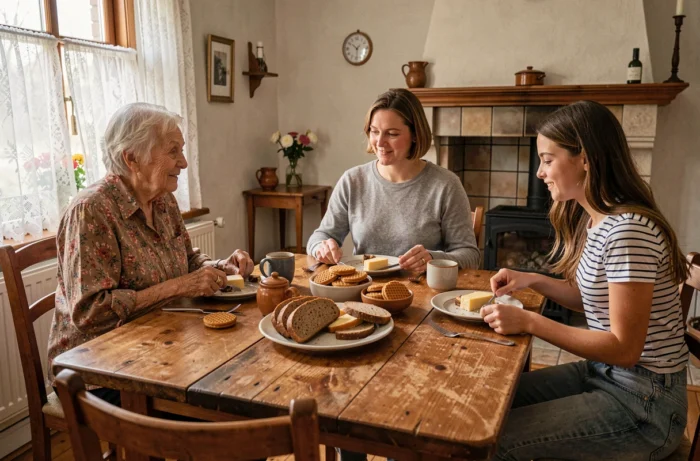
Oma does not stand alone. The term is part of a consistent family vocabulary system that is useful to learn as a whole:
- Opa is the informal term for grandfather, the exact counterpart of oma. The formal form is grootvader.
- Kleinzoon (grandson) and kleindochter (granddaughter) complete the next generation. Kleinkind means grandchild, regardless of gender.
- Vader (father) and moeder (mother) are the basic terms, with hun and haar used to indicate possession depending on the context.
- Schoonmoeder and schoonvader refer to parents-in-law, and should not be confused with stiefmoeder and stiefvader, which are used for blended families.
The distinction between schoon- and stief- is a common source of confusion for French speakers, since French uses “belle-mère” and “beau-père” for both. Dutch requires a lexical choice where French remains ambiguous.
Oma therefore means much more than its translation. The term encodes a register, a regional identity, and a place within a family vocabulary system in which each relationship has its own word. Remembering oma without understanding this network of terms is to grasp only the surface.