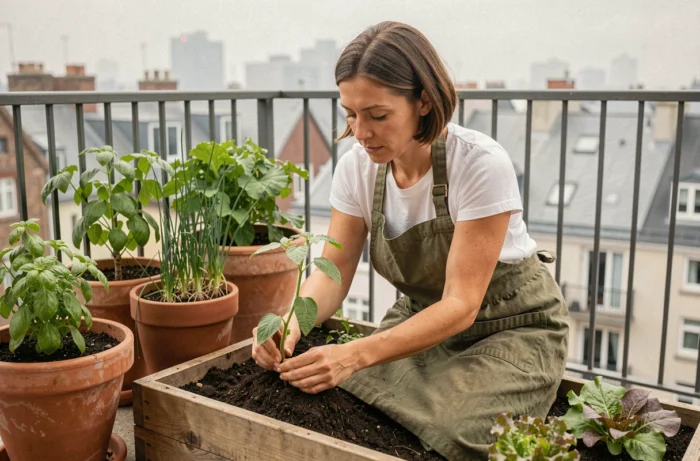
A productive vegetable garden depends on three technical factors: the depth of soil available for roots, the number of hours of direct sunlight, and water management. When space is limited to a few square metres—a balcony or courtyard, for example—these three factors become the only real levers for improving yields. Understanding how they interact makes it possible to grow a useful quantity of vegetables without a traditional garden plot.
Growing medium depth and root development: the constraint imposed by containers
Most small-garden failures are caused by a growing medium that is too shallow. Lettuce needs only about 15 centimetres, but a cherry tomato needs at least 30 centimetres of soil to develop a root system capable of supporting a good crop. Container depth determines yield, not its width.
In pots or planters, the growing medium dries out faster and heats up more than garden soil. A mix of potting soil, mature compost and a drainage material (perlite, pumice) helps limit this effect.
Compost supports soil life, but access to it varies depending on your situation: an individual compost bin, a shared compost bin at the foot of your building, or local food-waste collection. Before relying on homemade compost, check what is actually available.
The resources available in Cultivons nos Racines’ vegetable garden section cover companion planting and growing media suited to each type of vegetable. A good growing medium, carefully prepared once, can last for several seasons without needing to be completely replaced.
Vertical gardening and tiered planting: make use of height, not just floor space
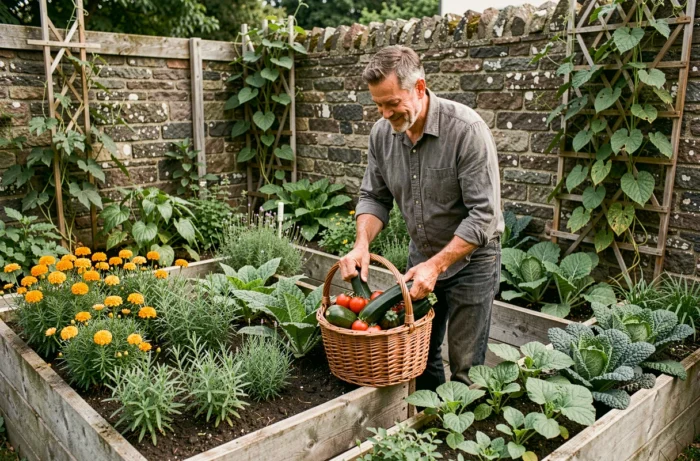
On a balcony or in a narrow courtyard, horizontal space is the scarcest resource. Vertical gardening turns a wall, railing or simple trellis into a growing area. It is not just a decorative gimmick: one square metre of vertical space can produce as much as one square metre of ground space when you choose suitable plants.
Climbing plants and hanging planters
Climbing beans, cucumbers and some compact squash varieties naturally grow up supports. A trellis fixed to a wall or netting stretched between two posts is all you need. Strawberries and herbs (thyme, basil, parsley) do well in hanging pockets or planters attached to the railing.
Tiering also works horizontally: planters of different heights let you place taller plants at the back (tomatoes, peppers) and shorter ones at the front (lettuce, radishes), so the taller plants do not deprive the others of light.
Weight limits and condominium rules
A planter saturated with water weighs considerably more than you might expect. Before placing several containers on a balcony, make sure the structure can support them, especially in older buildings. Condominium rules may also prohibit certain exterior fixtures or restrict changes to the building’s façade. Checking the load capacity and condominium rules can help you avoid costly disputes.
Water management in a small-space vegetable garden
Watering is the most time-consuming daily task in a container garden. Soilless growing media lose moisture much faster than garden soil. Two techniques can reduce how often you need to water without compromising growth.
- Surface mulching (straw, dried grass clippings, fallen leaves) slows evaporation and keeps soil temperature more stable, even in a planter exposed to full sun.
- Self-watering systems (planters with water reservoirs, or ollas buried in the growing medium) release water slowly to the roots and can extend the time between waterings by several days.
- A drip-irrigation system connected to a simple timer can water several containers at an adjustable flow rate, eliminating the risk of forgetting to water during hot spells.
Collecting rainwater is a practical way to supply a small vegetable garden. A compact water butt connected to a downpipe provides low-lime water that is ideal for plants. However, during watering restrictions imposed by a prefectural order, the rules may also apply to stored rainwater. Check the local order or the VigiEau website to find out which rules are in force in your municipality.
Crop rotation and companion planting for a natural vegetable garden all season long
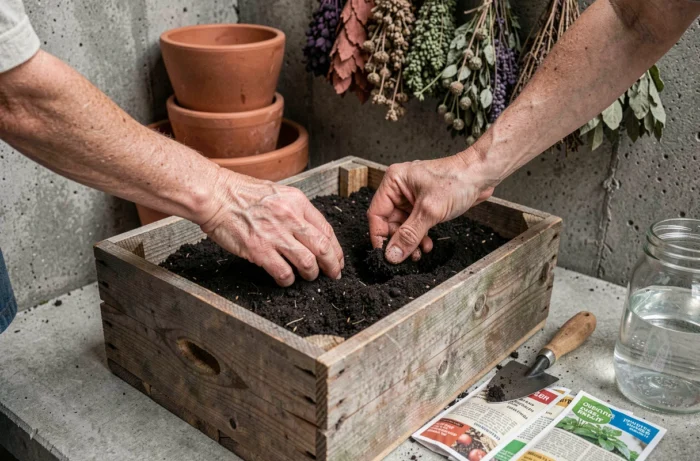
Limited space is no reason to skip crop rotation. Growing tomatoes in the same planter year after year depletes the growing medium and encourages fungal diseases. Even with just three or four containers, alternating plant families (nightshades, legumes, alliums) from one season to the next helps preserve soil fertility.
Companion planting has a direct impact on yields. Basil planted at the base of tomato plants deters some pests. Radishes sown between rows of carrots mark the rows and free up space before the carrots need it. Companion planting reduces the need for treatments and increases growing density.
In a small vegetable garden, succession planting in the same season takes the place of expanding the growing area. A planter of lettuce harvested in June can be planted with dwarf beans in July, then lamb’s lettuce in September. Keeping the growing medium planted also limits weed growth and maintains soil biological activity.
- Spring: radishes, lettuce, spinach, peas
- Summer: cherry tomatoes, peppers, basil, dwarf beans
- Autumn: lamb’s lettuce, rocket, kale, parsley
Three well-planned successions in the same planter produce more than a single crop cycle across twice the area. A sowing calendar tailored to your climate zone becomes the key tool for managing a small vegetable garden.
The final point to keep in mind is patience: a living growing medium, gradually enriched with compost and protected by mulch, becomes more fertile each year. The first harvests are rarely the best. By the second and third seasons, once the soil is biologically active and any mistakes in quantities have been corrected, yields improve significantly without adding chemical fertilisers.