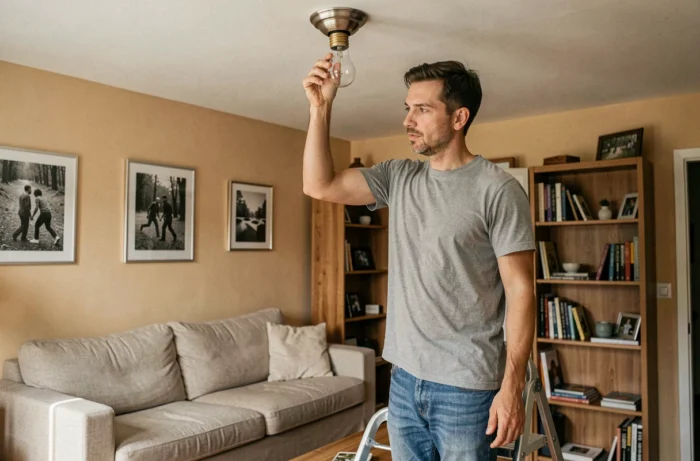
In a furnished rental, a burnt-out light bulb regularly sparks disagreements between tenants and landlords. The question may seem trivial, but the answer is governed by specific legal provisions: Decree No. 87-712 of August 26, 1987 lists tenant-responsible repairs, and the law applies the same routine maintenance obligations to furnished rentals that serve as a tenant’s primary residence. The key is knowing where to draw the line between a simple replacement and a fault that falls to the landlord.
Tenant and landlord responsibilities: a comparison of electrical repairs
Responsibility for costs is not left to the parties’ discretion. The 1987 decree and provisions of the Construction and Housing Code draw a clear distinction between routine maintenance and major repairs.
| Item | Tenant’s responsibility | Landlord’s responsibility |
|---|---|---|
| Light bulbs and fluorescent tubes | Replacement due to normal wear and tear | Replacement if the light fixture is worn out or the installation is faulty |
| Switches and outlets | Replacement of switches, electrical outlets, and fuse covers | Bringing the installation up to code and rewiring the electrical circuit |
| Light fixtures supplied with the furnished rental | Routine maintenance (cleaning and replacing bulbs) | Replacement of a fixture that has stopped working due to normal wear and tear |
| Electrical panel | Replacing fuses and resetting circuit breakers | Replacing the panel and work on the main electrical network |
This table reflects the principle behind the decree: anything that wears out through normal use is the tenant’s responsibility. As soon as the fault affects the installation itself or is due to wear and tear, responsibility shifts back to the landlord.
To learn more about who is responsible for replacing specific light bulbs in a furnished rental, the distinction between a standard bulb and an integrated light fixture is key.

Burnt-out bulb or faulty light fixture: the distinction that changes everything
A bulb that stops working after several months of use needs routine replacement. The tenant buys a new bulb, installs it, and covers the cost. This rule applies to both unfurnished and furnished rentals.
The situation changes when the problem is not the bulb. A ceiling light with a faulty ballast, a socket that no longer makes contact, or a recessed spotlight with a failed transformer: these faults concern the light fixture or the electrical installation. Tenants are not required to pay for repairs to equipment that has failed due to wear and tear.
The law explicitly excludes repairs caused by wear and tear, poor workmanship, or a construction defect from the tenant’s responsibilities. In practice, three signs can help determine who is responsible:
- A new bulb works in another fixture but not in the one in the rental: the problem is with the socket or fixture, not the bulb.
- The fixture was already reported as faulty in the move-in inspection report: the landlord is responsible, regardless of the nature of the fault.
- Several bulbs burn out in a short time on the same circuit: a power surge or faulty installation may be to blame, making it the landlord’s responsibility.
Move-in inspection report and proof of wear and tear in a furnished rental
The move-in inspection report is the reference document in the event of a dispute. In a furnished rental, it must describe the furniture and equipment provided, including light fixtures. If a bulb is missing or a fixture is marked as “not working” at move-in, the landlord is directly responsible.
The law sets out how wear and tear must be taken into account. A wear-and-tear schedule, attached to the lease or established through a collective agreement, may specify the expected lifespan of equipment. If a light fixture has exceeded that lifespan, the tenant’s share of the cost is reduced proportionately.
What to do if the inspection report does not mention the light bulbs
If the report does not mention them, the rental is presumed to have been handed over in good condition. If tenants find on arrival that a bulb is missing or a fixture does not work, they should report it in writing within the first few days. A registered letter sent within the first ten days of occupancy can be used to add details about heating equipment to the inspection report (and, by extension, to document any other issue).
Without written evidence, tenants risk being charged for the expense at the move-out inspection, with the amount deducted from their security deposit.
Departmental Conciliation Commission: recourse in disputes over light bulbs
A disagreement over replacing a bulb or light fixture does not always warrant legal proceedings. The Departmental Conciliation Commission handles rental disputes involving furnished properties, including disputes over repairs.
There is no fee to file a request. The tenant or landlord sends a letter to the commission in the department where the rental is located. The commission summons both parties and tries to reach an amicable agreement. If conciliation fails, either party may still take the matter to court.
When conciliation makes sense
For a bulb that costs just a few euros, the process may seem disproportionate. It becomes worthwhile when the landlord refuses to replace an expensive light fixture, claiming it is part of routine maintenance, or when a deduction from the security deposit covers several disputed electrical items. In a furnished rental, the security deposit is capped at two months’ rent, excluding charges, and any deduction must be supported by documents (quotes, invoices, and a comparison with the move-in inspection report).
Replacing a light bulb is one of the most common routine maintenance tasks in a rental. The tenant’s responsibility ends where a fault in the electrical installation or wear and tear on the equipment begins. Documenting the property’s condition at move-in, keeping proof of purchase, and promptly reporting any issues: these three simple steps are enough to prevent most disputes on this subject.