
A cohesive interior relies less on choosing a ready-made style than on managing technical constraints that are often overlooked: air quality, material compatibility and the visual hierarchy of spaces. Home decorating and layout become more effective when these factors guide decisions before you even choose a colour or a piece of furniture.
Emissions from decorative materials: how VOC labels affect an interior design project
Every material introduced into a room—paint, flooring or furniture panels—releases volatile organic compounds. The regulatory label, rated from A+ (very low emissions) to C, provides a guide for each product. The catch is that it assesses each product individually.
When you combine A+ laminate flooring, A+ wall paint and A+ particleboard furniture, emissions accumulate in the same volume of air. The second national housing survey, conducted from 2020 to 2023 by OQEI and compared with the 2003–2005 survey, found a decrease in several pollutants, but confirmed that sources of pollution include materials and furniture as well as cleaning and DIY products.
In practice, this means a decorating project should account for ventilation from the design stage. Before approving a palette of finishes, we check the room’s air exchange rate. An undersized mechanical ventilation system or vents blocked by furniture can negate the benefits of an A+-rated product. Ventilating during and after installation remains the most effective advice, even for paints described as “low-odour”.
Among home decorating ideas, choosing untreated solid wood, mineral paints or lime plaster mechanically reduces VOC levels compared with synthetic alternatives, while adding a texture that industrial finishes struggle to replicate.
Reused furniture and vintage finds: technical checks before bringing them into your home
Vintage furniture and reclaimed objects are playing an increasingly prominent role in interior design. Style guides show the visual result, but rarely the work that goes into it. A second-hand find is not necessarily ready to use.
Before bringing a reclaimed piece into your home, it’s worth checking several technical details. Monsieur Magazine’s home section regularly covers these questions of layout and furniture choices with sustainability in mind.
- Structural stability: loose mortise-and-tenon joints, cracked legs and warped tabletops. Tightening or regluing with PVA glue is often enough, but a broken chair leg needs replacing, not just gluing.
- Finish compatibility: old lead-based varnish or outdated fungicide treatments can pose a health risk. The right approach is to strip the finish and re-treat the piece with a product that meets current standards.
- Fire safety of textiles: a reclaimed sofa or armchair whose original fabric no longer meets fire-resistance requirements should be reupholstered with M1- or M2-rated fabric.
- Electrical safety: vintage light fittings with non-standard sockets or degraded wiring need to be completely rewired before use.
These checks turn a decorative object into a safe, functional piece—and it is precisely this step that distinguishes a thoughtfully curated vintage interior from one that is simply cluttered.
Colour palette and visual hierarchy: bring structure to a room without overwhelming it
Colour is still the most accessible decorating tool, but also the one most often misused. Piling the “colours of the year” into a single space can make it feel chaotic. A well-balanced room uses no more than three colour levels: a dominant colour (walls, floor), a secondary colour (main furniture, curtains) and an accent colour (objects, cushions, wall art).
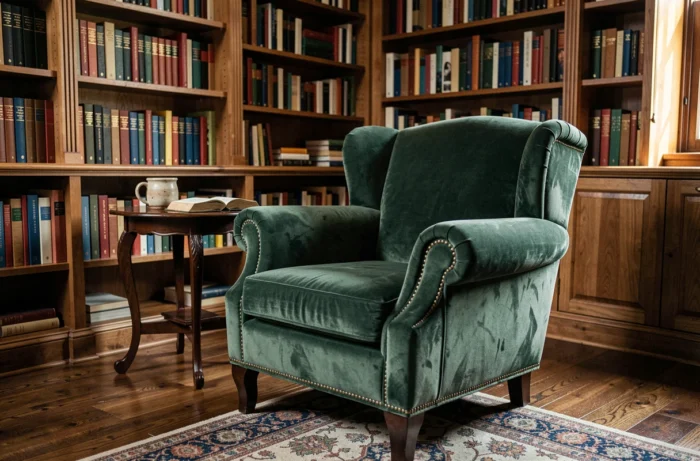
The dominant colour covers around two-thirds of the visible surfaces. It sets the overall mood: neutral tones create a bright, flexible space, while saturated shades create a cocooning effect. The secondary colour guides the eye towards key pieces of furniture. Used sparingly, the accent colour creates focal points.
Wood, whether light or dark, counts as a colour in its own right within this hierarchy. Mixing whitewashed oak, walnut and pine in the same room without a visual link disrupts the cohesion just as much as a three-colour wall. Choosing one dominant wood species for the main furniture, then adding contrast with a single element (a shelf or a frame), creates a cleaner look.
Space planning: using furniture to define zones
In open-plan interiors (living room and kitchen, or a studio), furniture takes the place of walls to define living areas. A sofa positioned with its back to the dining area creates a clear division without blocking the light. A console table or low bookcase works better than a room divider because it adds storage while separating the space.
Movement between zones matters just as much as defining them. A gap of less than one metre between two pieces of furniture creates a daily bottleneck. Before deciding where to place a piece, map out the usual routes (from the entrance to the kitchen, or from the sofa to the bathroom) to avoid costly adjustments later.
Decorative objects can also mark out zones: a rug defines a living area, while a low-hanging pendant light signals the dining table. These design elements are more than simple ornaments; they help make the room functionally clear.
A successful layout doesn’t necessarily require changing everything. Rearranging existing furniture, adjusting the lighting and reducing the number of visible objects in each area to five or six is often enough to transform how an interior feels. The most effective decorating knows when to take things away as well as when to add them.