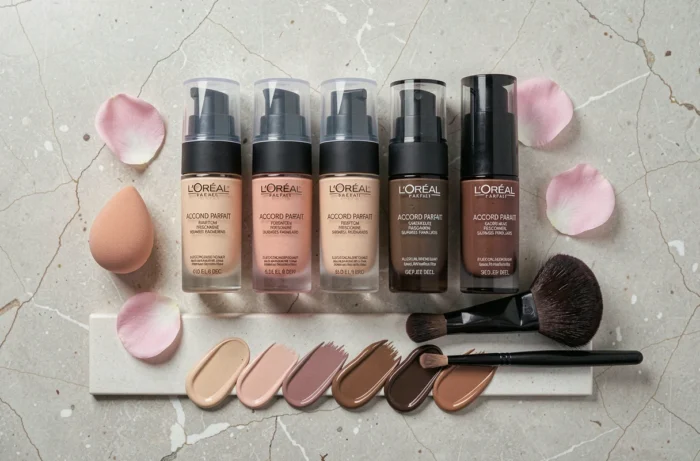
The L’Oréal True Match foundation range can include up to 48 shades, depending on the retailer. With such a wide selection, choosing the right one depends less on intuition than on reading the code printed on the bottle.
Each shade combines a letter (N, D or R) and a number, indicating the undertone and depth respectively. Understanding this coding system can narrow down the options to two or three candidates before you even test the product on your skin.
True Match shade codes: letters, numbers and undertones
The True Match shade range uses a two-part code. The letter identifies the foundation’s color tone, while the number indicates its depth, from lightest to darkest.
| Letter | Undertone | How it looks on the skin |
|---|---|---|
| N | Neutral | Neither distinctly yellow nor distinctly pink |
| D | Golden | Warm undertone, leaning yellow or peach |
| R | Rosy | Cool undertone, with pink or red hues |
Two shades can share the same depth number yet look very different on the face. A D3 and an R3 cover the same lightness range, but the former leans golden while the latter has a rosy cast. The undertone is what distinguishes two shades with the same depth.
Choosing the wrong letter creates a more noticeable color mismatch than a slight error in depth. A foundation that’s too golden for skin with a rosy undertone can look yellow around the jawline, whereas the difference between two consecutive numbers is barely noticeable in natural light.
To find out which L’Oréal True Match foundation shade suits your skin tone, reading the code is the first step before applying any product.
Identify your skin’s undertone before choosing a True Match shade
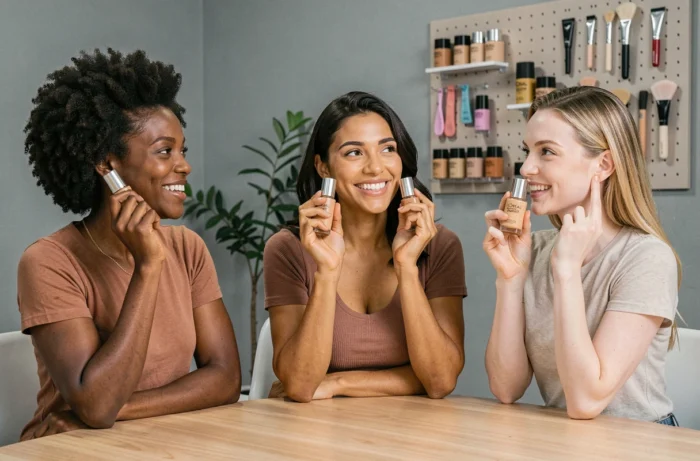
Undertone is not the same as the surface color of your skin. Fair skin can have a golden undertone, and deep skin can have a rosy one. Several physical clues can help you decide.
- Look at the veins on your wrist in natural light: blue or purple veins suggest a cool (rosy) undertone, greenish veins suggest a warm (golden) undertone, and a mix of both points to a neutral undertone.
- How your skin reacts to the sun: skin that tans easily without turning red often has a golden undertone, while skin that turns red before tanning tends to have a rosy undertone.
- Which jewelry flatters your complexion: gold enhances warm undertones, while silver suits cool undertones. If both work for you, your undertone is probably neutral.
These combined tests won’t give you absolute certainty, but they can help you identify the right letter (N, D or R) in the True Match shade range. Cross-checking at least two clues reduces the risk of choosing the wrong shade compared with relying on just one criterion.
Number of True Match shades: availability varies by retailer
The True Match range isn’t the same everywhere. Some French retailers list 48 available shades, while other markets or platforms offer around twenty. This variation is due to each retailer’s stock selection and, in some cases, differences in the formula between local versions of the product.
In practice, a shade number found on a foreign website or an old product listing doesn’t always match what’s sold in France. Before ordering online based on a code found on a forum, check that the shade is listed in the French retailer’s catalog to avoid an unwelcome surprise when it arrives.
Consumer tests and the limits of shade-matching claims
L’Oréal supports the True Match promise with consumer tests. Nocibé mentions a study involving 211 women, while Douglas cites a separate panel of 291 participants. These results confirm the range’s breadth across a group, but they don’t guarantee that the shade you choose will suit everyone.
Testing the product on your own skin is the only reliable way to check. Online diagnostic tools (such as a “shade finder”) can help narrow down your options, but they can’t replace applying a small amount along your jawline in daylight.
True Match foundation oxidation: a pitfall to watch out for
Foundation can darken or change tone within minutes of application. This phenomenon, known as oxidation, depends on your skin’s pH, sebum production and the product’s formula. Some True Match users report that the foundation turns more golden or darker after an hour of wear.
Test the shade and wait at least thirty minutes before making your decision so you can see whether it changes. A shade that looks perfect when first applied may turn out too dark after oxidizing, which is why some people opt for a half-shade lighter than the one that seemed ideal in store.
Adjust your shade for seasonal tanning
Your skin tone changes between winter and summer. Having two shades (for example, a D2 for winter and a D3.5 for summer) accommodates this fluctuation without having to mix two bottles. Your undertone letter generally stays the same all year; only the depth number changes.
The True Match coding system makes this adjustment easy: moving up or down one step on the numerical scale is enough in most cases, as long as you keep the same undertone letter. Your undertone doesn’t change with a tan; only your skin depth does.
Choosing a True Match shade comes down to understanding three factors: the undertone letter, the depth number and how the product behaves as it oxidizes. L’Oréal Paris’s wide foundation range offers genuine precision, as long as you don’t rely solely on how the bottle looks on the shelf.